
TEXTS
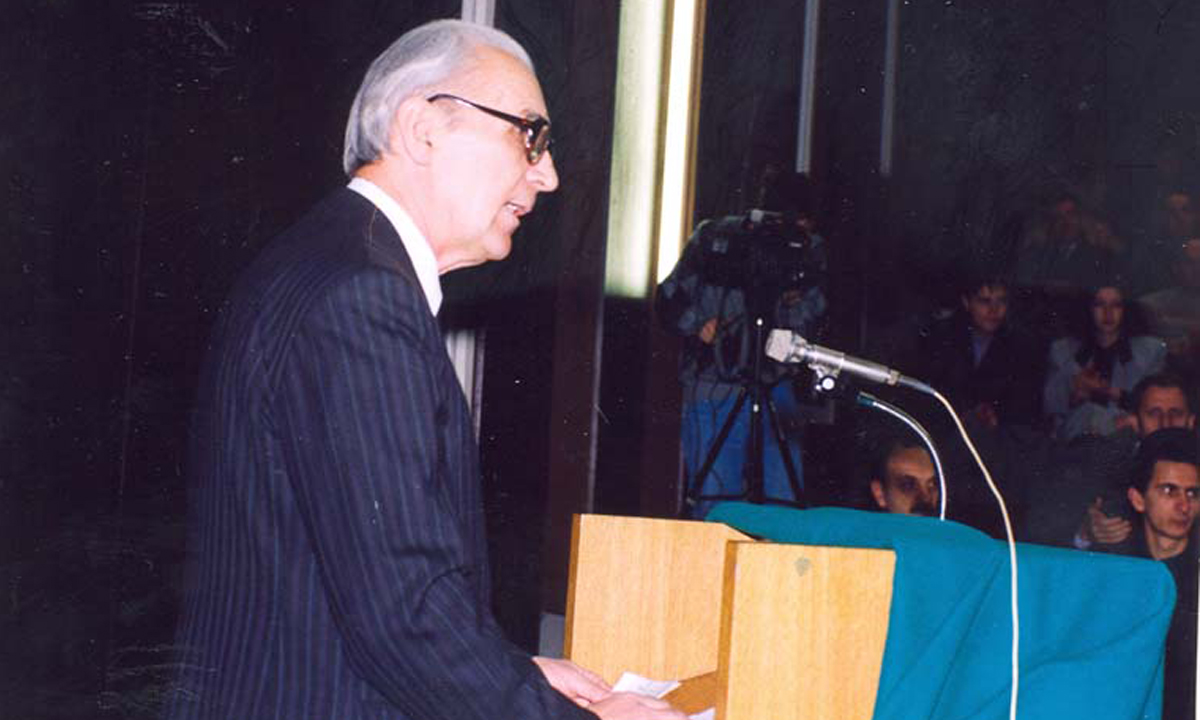
Speech at the Re-establishment Assembly of 'Preporod' (1990)
Muhsin Rizvić
Ladies and Gentlemen, Distinguished Guests,
Today, we are witnessing a significant and historic moment in the cultural renaissance of our people. We are taking part in the revival of the “Preporod” society as a central institution for gathering and bringing together not only Bosnian Muslims, but also our compatriots in other parts of Yugoslavia, as well as our emigrants scattered across all four corners of the world.
We are laying the foundations for the integration of our creative forces in the noble mission of nurturing, developing, and studying our culture and history, science and art. All of this is to be achieved through an equal and fruitful relationship with the cultures and scientific achievements of other peoples and civilizations.
Many of you, who were children after the war, may not know that in the renewed Yugoslavia, in 1945, the activities of all pre-war national cultural and educational societies were revived. Thus, from the former “Gajret” and “Narodna uzdanica,” the Muslim society “Preporod” was established, carrying in its name a concept of multiple meanings and significance. This concept embodied a sense of remembrance and maintained a connection with the Bosnian Muslim cultural and educational revival at the turn of the 19th and 20th centuries, a time of transition between historical epochs and the full affirmation of national identity and distinctive features: the native language and history, folk literature and culture, work for the people with a vision toward future progress, and openness to the achievements of Western culture, civilization, and science. The name of the society “Preporod” also carried with it the idea of cultural and political unification of Bosnian Muslims, overcoming the interwar national and political orientations of the Muslim intelligentsia, in contrast to the cultural and spiritual unity of their people, who, having learned from the tragic experience of wartime suffering, could be nothing other than united, self-aware, and Muslim. However, during the brief existence of the post-war “Preporod,” it became evident that the society had been founded with the intention of gathering Bosnian Muslims around the program of the new socialist authorities, whereby culture was subordinated to political objectives. Since national characteristics stood in the way of the politicization and unitarization of culture, “Preporod” was abolished, together with “Prosvjeta” and “Napredak,” in 1949, following the insistence of representatives of the Ministry of Education at a session of the so-called Coordination Committee. Archival documents even testify that this decision was made despite the opposition of representatives of the societies, who argued that such a decision could only be made by their respective assemblies.
At that time, Bosnian Muslims found themselves in the position of a people that existed in terms of everyday life, but did not exist nationally — a people threatened by assimilation, in danger of losing what they were and what they had historically possessed, and of being absorbed into those nations which they were not. Somewhat earlier, in 1947, they lost the name by which they had been known during the war and in the pre-war period, a name that disappeared without a trace from official use, as they were abolished as a Yugoslav constituent people. Then, in 1949, they were deprived of their cultural and educational society as well — the only, at least nominally, national institution of their own — and this situation lasted for a full forty years. This occurred amid the open divide created by a new sectarian-ideological schism among the Muslim intelligentsia and a renewed separation from the majority of the Muslim people. After two decades, in 1967, the name was officially returned to us by political decision; our nation was “recognized,” as it was then absurdly, and sometimes cynically, stated. But it was a nation deprived of its essence: without institutions, historically and culturally humiliated, strictly controlled and monitored to ensure that the boundaries of permitted cultural expression were not crossed. For our national cultural and educational society was never restored, nor were such societies restored to others in Bosnia and Herzegovina. Even in the 1970s, a fierce campaign was launched against any idea of national cultural institutions in Bosnia and Herzegovina. The once noble and patriotic concept of the national was deliberately associated with an ugly meaning of chauvinism, accompanied by apocalyptic allusions to a fratricidal war.
Thus, for forty years we have been and remain, to this day, the only people — not only within the Yugoslav community of peoples, but in Europe as well — without cultural autonomy, without our own cultural institutions. As a result, we have been left with literature whose legitimacy has been questioned, a language that within Yugoslav linguistics has not been granted the right even to its traditional name, let alone to its lexical participation; with a history that is suppressed through historical guilt and the so-called “Turkish complex”; and with a culture accused of having interrupted the development of spiritual life in Bosnia.
I believe that, at this point in my address, some may pose a question for ethnologists and cultural sociologists: How is it that, despite all these trials and predictions — which, fortunately, did not come true — our people managed to preserve their own identity, distinctiveness, and ethnic uniqueness? How did they preserve their cultural-historical and spiritual being? How did they avoid the temptations of assimilation and the danger of disappearing from the cultural and geographical map of Southeastern Europe?
The answer, in this unusual and unique case, is ethnologically natural, historically logical, and psychologically clear: It endured because it existed in a state of balance — not to say a Buridanian position — *between* East and West, between the cultures of the two other Yugoslav peoples who shared the same language, *between* Vuk and Gaj, in a comparative position of enrichment and mutual fertilization, but also of its own distinctiveness. It endured through defiance, through strength and steadfastness of character, but also through the conviction that “to endure one’s fate means to overcome it,” despite political and national denial, moral doubt, and the constantly open paths toward turning away and merging into other peoples. The reactive feeling of resistance to nihilistic pressures, the dangers of cultural eradication, and historical erasure was, in this case, productive and effective because it had a constant foundation in its own self-awareness during this critical, interstitial position. It was the awareness of the originality and uniqueness of its own national being, of its spiritual and historical-cultural distinctiveness among other Yugoslav peoples; the awareness of its own “sweet maternal song,” through which countless songs had been sung, countless stories told, and countless wise proverbial sayings spoken since ancient times. Or, as the poet spoke to his heart amid the captivating surroundings of the great creators of other peoples — with a skeptical awareness of the final understanding carried on the wings of imagination without aim or direction, with a realization of the emptiness of following foreign models and the authenticity of one’s own experience of beauty:
What drives you,
what compels you
To rise without aim or direction
On the wings of imagination,
Yet never reach your destination?
My beloved heart,
My lost heart,
Do not waste your time in vain;
Return to my breast again!
For when you reach Sina’s mountain,,
Where everything is bathed in light,,
Where the dark midnight turns to day,,
They will say to you: “Turn away!”
Beautiful voices from foreign lands,
While you are lulled to sleep in love,
Will enchant you, young heart,
Like hunters pursuing a wild herd.
Hafiz, Khayyam, and Nizami,
Each one calls you to himself;
Make friends with them all,
Then return to my breast again.
You recognize him — it was Bašagić, eighty-five years ago: our great poet and playwright, historian of Bosnia, a Viennese Doctor of “ex linguis islamiticis,” founder of Yugoslav Oriental studies, the first reformer of Muslim society, initiator of the journal *Behar*, and founder of the first Muslim cultural and educational society, “Gajret,” a name meaning effort, dedication, encouragement, zeal, and enthusiasm for action, as well as devotion to its goals. There lies his grave in the courtyard of Gazi Husrev-beg Mosque, among the great figures of our first literary, cultural, and social revival. Let us place flowers on his grave today and pay tribute to his work and his memory. It was to him, and to the honorable Džemaludin ef. Čaušević, that all those of our leaders who sought to emancipate the Muslim world from everything conservative that stood in the way of social progress and cultural advancement turned for inspiration. We, too, may invoke these far-sighted and open-minded ancestors today, as we reconnect the threads of organized national and cultural development that were interrupted four decades ago. And let us respond to Bašagić with the verses of pride and recognition that he himself addressed to Mehmed Pasha Sokolović the Great:
Behold, even the golden-winged fairy
From the level fields of Nevesinje
Places a wreath upon your tombstone,
Our glorious memory.
O, receive it! It is woven
From the flowers of your native soil;
In the sweet maternal song,
May it be a tribute to your glory.
And let us pay tribute to Čaušević with words of humble respect, the same words that Musa Ćazim Ćatić uttered sorrowfully “at the grave of his teacher”:
In Your sun, I warmed my heart,
From Your spirit, my wings grew;
From Your spring, I drank of blessings.
Indeed, the shining rays of Your great mind
Were the guiding lights of my young soul,
That led me along the true path…
in both directions, with a reciprocal interaction of activities, so that this interplay of efforts, in the sense of continuous progress and improvement, should represent an essential mechanism of this institution’s work.
Since the character of this society is essentially determined by the being and life, the spirit and history of our people — from the past, through the present, and into the future — and since it derives from that very essence, it is only natural that the results of the activities of “Preporod,” in the fields it encompasses, are intended for and returned to that same people as knowledge about themselves, scientifically interpreted and artistically enriched, directed toward the 21st century.
For we do not live today in an age of emotions and romanticism; we live in a world of critical reason, verification, and deeper inquiry. And when, driven by the curiosity of discovery, we return to the world from which we emerged, we truly cannot return in any other way than with a modern sensibility and a liberated spirit, with the perspective of contemporary understanding and a desire for the scholarly reassessment of everything we have inherited from the past.
It is precisely from this that the second aspect of the Society's mission follows: to emerge from the cocoon of its own national and cultural identity and its limitations, and to open itself without boundaries to the broader horizons of world civilization and culture. More than a century ago, Bosnian Muslims convincingly demonstrated their vitality by proving that they could keep pace with the development of modern civilization; that, within the framework of their own national identity, they could harmonize their lives, their work, and their creative spirit with those of more advanced nations and their cultures; and that our language, as Bašagić observed with a realistic vision, “can nurture, can unite East and West, poetry and reason.” From those times until today—including the twenty-year hiatus of our national anonymity, despite our continued creative existence—this vitality has been attested by the impressive body of our achievements and accomplishments. Even under unfavorable social and political circumstances and limited opportunities for development, a remarkable succession of our great writers, artists, and scholars emerged. As enduring values, they belong to the pantheon of our culture and spirit, regardless of their personal ideological or political convictions. For culture, science, and art, free from ideology and politics—this shall be the fundamental principle and moral foundation of our Society—together with a civilized respect for freedom of thought and the intellectual convictions of every individual, provided they are not accompanied by base motives or by an affront to human dignity. Therefore, despite changing times and shifting social and political systems, we are far removed from the notion that, because of differing opinions, we should trample underfoot our greatest minds, just as Shakespeare's Ophelia tears flowers from the garland that adorns her face. Having learned from the political orientation of the former “Preporod” and from the national deviations of the societies from which it emerged, our restored institution will be non-political and non-partisan. Yet, through its programs and activities, it will bring together all creators and collaborators who can contribute to the cultural foundations of our people, gathering into its central current the entire course of our nation's spiritual and social life—from the past to the present: from its springs and sources, all its tributaries and branches, all its currents and underground streams, its backwaters and its rapids. Within that great current, every single drop is significant, for:
When a drop reaches the sea, it disappears.
It is no longer a drop, but takes the name of “the seven seas.”
The drop is truly water; it is only separated from the water.
When it falls back into the water, it becomes water again.
Thus, four centuries ago, our mystical poet Ahmet Bošnjak Vahdeti (“the One”) from Dobrun near Višegrad reflected upon the category of universal unity. And this is one of the voices from our ancient literary past that, through its wisdom, speaks to us today. It calls upon us to free ourselves from the burden of conscience for having been silent witnesses to the interruption of our cultural and social continuity. But the decision on “Preporod” that you are about to make will not be a decision from those days when politics pushed culture aside and led us into a national dead end. What you are to adopt today is an expression of our present time and of the needs of our collective being, so that we may enter into cultural dialogue and comparison with other peoples as equals and with confidence. Through this decision, the people whose enlightened offspring you are will recognize the qualities it cherishes: independence, profound wisdom, and nobility. And you will help this people, through comprehensive culture, art, and science, to rise to that level upon which the most advanced peoples of the world stand.
Only then will it be adorned with harmony, and its spirit with self-confidence. With these ideas, feelings, and commitment to work, I call upon you, as contemporaries of the modern age, aware of your national identity, to join in the official awakening, renewal, and revival of the “Preporod” society, so that in the future it may affirm and even surpass not only its substance, but also its very name.